

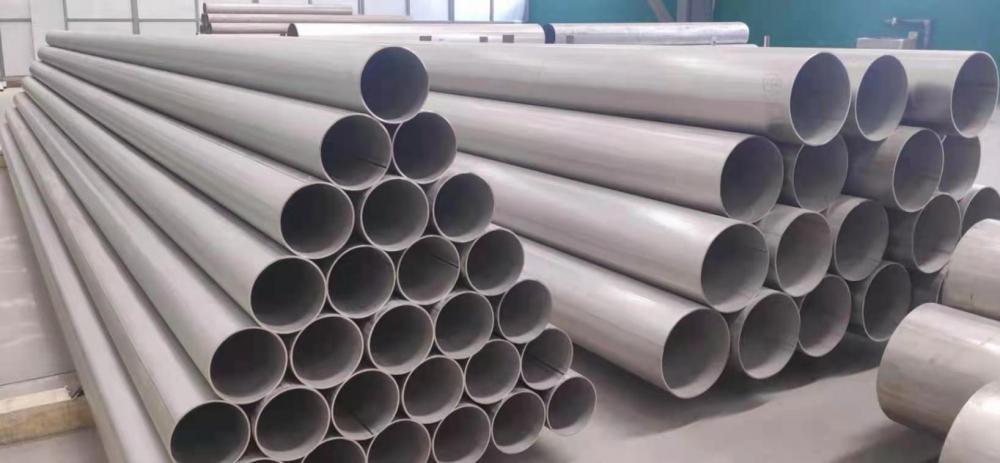
Titanium alloy has the characteristics of low density, high strength and corrosion resistance. Titanium alloy pipe, as a new kind of material, is widely used in the field of aerospace, and the proportion of titanium alloy pipe in aero-engine pipeline is increasing. Other, titanium alloy is a very lively metal at high temperature of oxygen, hydrogen, nitrogen and other gases has a great affinity, absorbed and dissolved gas ability is very strong, especially in the welding process, the ability with welding temperature rises, the performance is especially intense, when welding need to absorb oxygen, hydrogen, nitrogen and other gases and dissolved control, avoid the abandonment of the product, This brings great difficulties to the welding of titanium alloy tube.
1. Weldability of titanium alloy catheter
(1) embrittlement of welded joints
At room temperature, titanium reacts with oxygen to form a dense oxide film, which makes it have better chemical stability and corrosion resistance. Under high temperature, especially in the welding process, titanium and oxygen, hydrogen, nitrogen reaction speed, when the molten pool in the invasion of oxygen, hydrogen, nitrogen and other harmful gases, welding joint of the plasticity, toughness and surface color has the obvious change, especially in the more than 882 ℃, sub grain growth tendency is serious, martensite structure are formed when cooling, The joint strength, hardness, plasticity, toughness decreased, overheating tendency serious, serious embrittlement of the joint. Therefore, in titanium alloy welding, the molten pool, molten drop and high temperature zone, whether positive or negative, should be comprehensive and reliable gas protection.
(2) Stoma
Porosity is the most common defect in titanium and titanium alloys welding, which mainly occurs near the fusion line. Hydrogen is the main cause of stomata. During welding, TITANIUM has a strong ability to absorb hydrogen (even stronger at high temperature), but its solubility decreases significantly with the decrease of temperature, so the hydrogen dissolved in the liquid metal often has no time to escape and accumulates near the fusion line to form pores.
(3) Delay crack near the seam area
Titanium alloy in a period of time after welding. Cracks tend to appear in the near seam area (delay cracks). The reason is that hydrogen diffused from the high temperature molten pool to the low temperature heat affected zone. With the increase of hydrogen content, the amount of TiH2 precipitated increased, which increased the brittleness of the heat affected zone. In addition, the microstructure stress generated when the volume of precipitated hydride expanded eventually led to cracks.
2. Welding requirements and matters needing attention for titanium alloy conduit
(1) Try to set up a special welding workshop, no smoking indoors, the environment should be kept clean and dry, and the air convection should be strictly controlled.
(2) Welders should wear clean work clothes and non-fat gloves when welding. It is strictly forbidden to touch parts with bare hands.
(3) The welding area and the surface of the wire should be degreased with acetone.
(4) Argon is protected with high purity, purity not less than 99.99%. During welding, the gas supply flow shall be protected on the front and back of the welding pass according to the value specified in the technological procedure.
(5) In the welding process, the flow rate of argon in the tube and the nozzle of the welding tool should be kept constant to prevent the convexity and concave phenomenon of the weld pool forming in the tube.
(6) When welding, short arc welding should be adopted as far as possible, and small welding line energy should be adopted.
(7) The gap is less than 30% of the wall thickness when the pipe is spot welded. Each weld should be welded at one time as far as possible.
(8) During welding, the welding tool should not swing from side to side, and the melting end of the welding wire should not be moved out of the gas protection zone. When starting the arc, air supply should be advanced for 10-15s. When resting the arc, the welding torch can not be lifted immediately. The air supply should be delayed for 15-30s until the temperature drops below 250℃.
3. Welding process
1) Clean up before welding.
The occurrence of welding defects is closely related to the surface cleanliness of weldment and wire. Before welding, grease, water, oxide film and other dirt within 15 ~ 20mm of the edge of the pipe joint and the surface of the welding wire should be cleaned. Cleaning methods can be chemical (pickling) or mechanical means (stainless steel brush) to remove the surface oxide skin. Acetone or alcohol should also be used to scrub before welding. After cleaning, the weldment must be welded within 24 hours, otherwise it needs to be cleaned again. Wire pickling after the best vacuum dehydrogenation treatment, degreasing with acetone before welding.
2) Gas protection. When welding titanium pipe joint, in order to prevent the welding joint from being polluted by harmful gases and elements at high temperature, necessary argon gas protection must be carried out on the weld with purity not less than 99.99%. Argon gas flow is shown in Table 2-1.
3) Selection of welding process parameters.
(1) Selection of welding wire. The grade of the filler wire should be selected according to the base metal, generally using the principle of homogeneity with the base metal, sometimes in order to improve the plasticity of the joint, you can choose a slightly lower degree of alloying than the base metal welding wire. The diameter of the welding wire should be selected according to the thickness of the base metal, as shown in Table 2-1.
(2) Power supply and polarity selection. Titanium and titanium alloys are generally welded by DC manual tungsten electrode argon arc power supply, and the polarity connection method is direct DC connection.
(3) Selection of tungsten pole. The diameter of tungsten pole is selected according to the thickness of titanium alloy tube wall, which is generally between 1.0-3.Omm. The tungsten extreme part should be ground into a cone of 25° ~ 45°.
(4) Selection of welding current and other parameters.